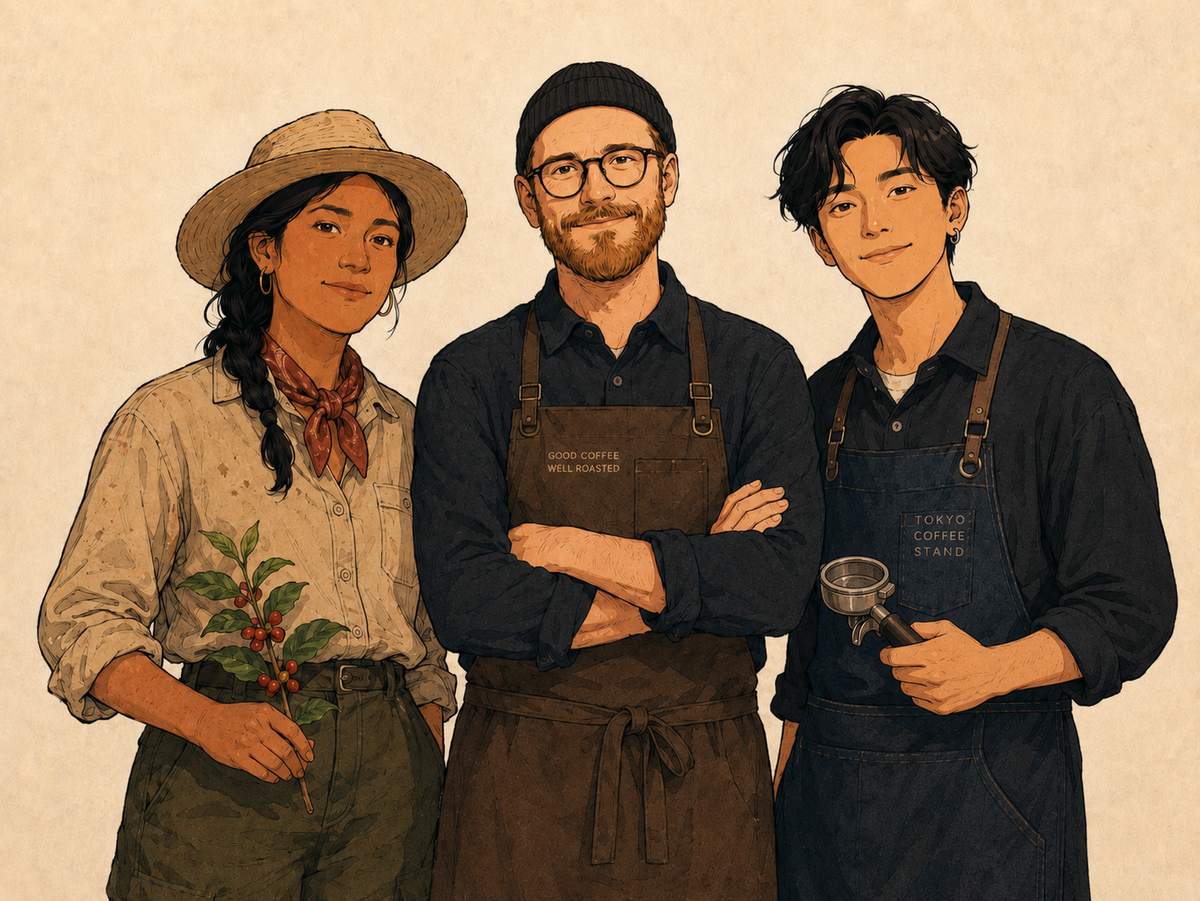
What Coffee People Are Telling Us
Across 27 conversations, coffee people describe the problems they face, what they want to change, and what keeps returning: cooperation, solidarity, shared knowledge, and the need for structures that make collective action possible.

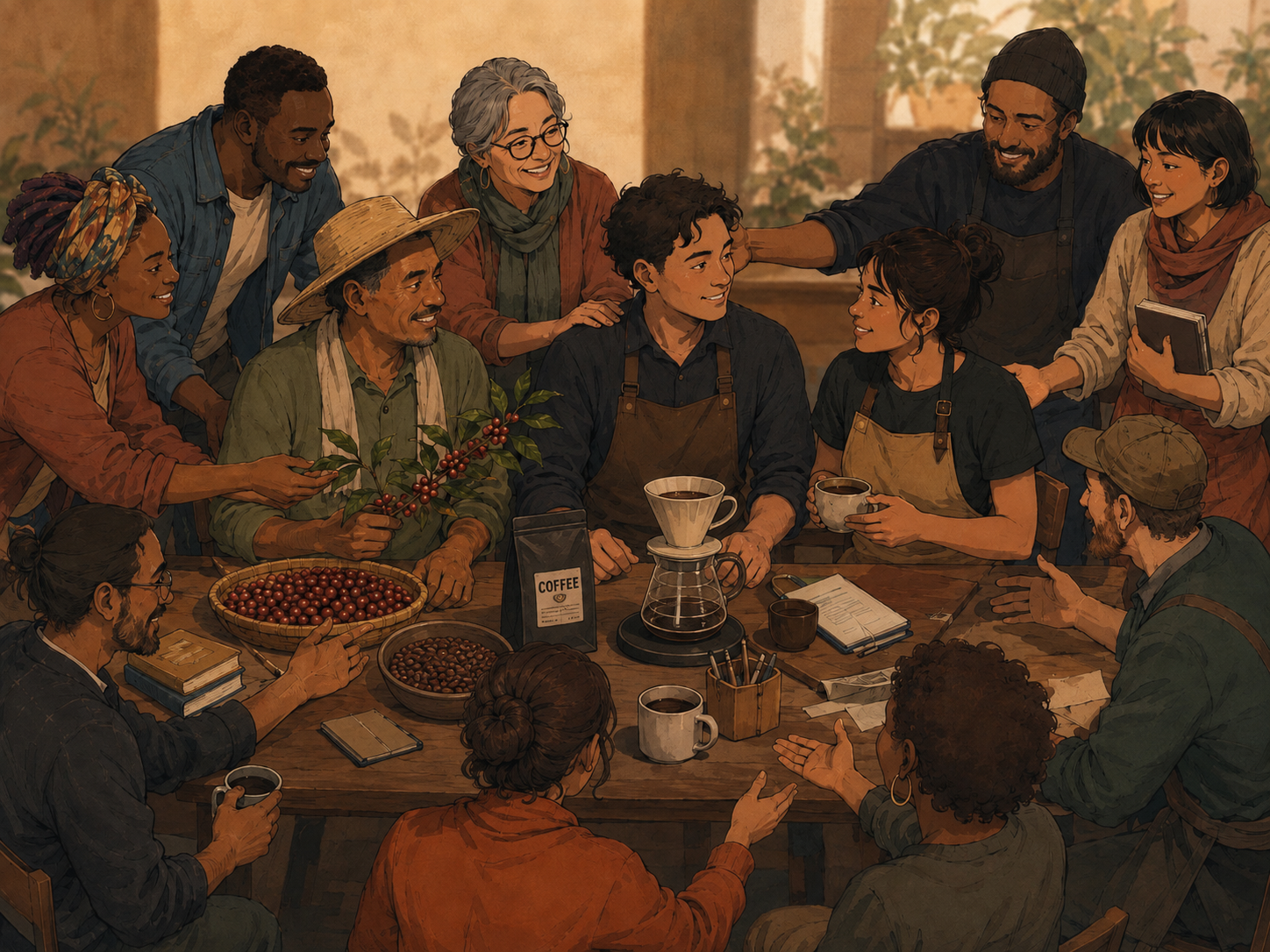
Coffee people are a society. Scattered across the world, with a territory drawn by coffee. Curious about the world, mobile, changing. Coffee people connect the farm, the lab, the roastery, the café, the office, the training room, and the cup someone is holding in their hand right now.
Over the summer months, we asked coffee people four things: who they are, what they are proud of, what problems they see in their part of the coffee world, and what they would change if they could choose one thing.
We published 27 conversations.
You’ll find all 27 conversations in the Signal below.
 Krzysztof Blinkiewicz
It’s worth reading the conversations with people whose names are appearing in your coffee world for the first time, too. Each of these perspectives brings its own piece of reality.
What came through in these answers was sensitivity, responsibility, courage, and humility. Persistence. Resilience. Independence.
We’re raising Pay-It-Forward contributions for three coffee people: a farmer or farm, a roaster or roastery, and a barista or café.
Each will receive access to The Places at no cost.
And alongside that independence, the need to work together kept coming up.
Coffee people talk about their own agency, while also looking for solidarity, shared knowledge, stable relationships, and spaces where people can act together. That tension seems to be one of the most interesting outcomes of the entire series.
Independence turns out to be something very different from loneliness.
Our interviewees mostly used the language of everyday work with coffee. Much of it was the language of specialty coffee. That matters to The Better Coffee Endeavour, because language shows us the boundaries of the world we operate in.
Specialty has created its own vocabulary of quality, professionalism, openness, and collaboration. It has also shaped how profits are made and distributed, how inequalities deepen, and how pointwashing and greenwashing operate. Along with it came a strong boundary between what belongs inside that category and the rest of the coffee market.
That boundary shapes how we describe people, products, success, and value. And how we act.
In the language of specialty, you can talk about openness while operating in an environment of gatekeeping. You can talk about collaboration while the economic outcome of that collaboration is distributed wildly unevenly. You can talk about change while preserving the mechanisms that keep producing the same inequalities.
Capitalism knows this logic well: a system can absorb the language of its own critique and turn it into another part of everyday practice. It can produce a dichotomy that makes it harder to agree on a shared direction and actually make change happen.
The Better Coffee creates a different language for coffee. A language that lets us name the mechanisms of exploitation, the costs, and the experiences of coffee people.
Coffee People, the series on Red Ink Coffee, took a different approach.
We gave people the pages, uncensored and unedited. We listened. We didn’t judge or argue back.
Openness to difference creates the conditions for understanding. A long, honest conversation over coffee remains one of the simplest ways to get to know another person.
That is why, with Coffee People, we opened the pages of Red Ink Coffee to people willing to spend a dozen or so minutes reflecting and talking about their own experience.
To everyone who answered: thank you for your time, your trust, and for leaving a piece of your world on our pages. And thank you as well to the people who started the conversation with us, even if their answers ultimately did not appear here.
The series also showed just how diverse coffee people are.
We spoke with coffee competition champions, farmers, baristas, roasters, educators, journalists, and people working with coffee equipment, events, quality, marketing, and scientific research. With a migrant whose professional future depends on getting a visa. With someone helping create standards we use every day in this industry. With someone working with plant-based milk. With a researcher working with roasted dandelion root and exploring how far the experience of a cup can reach.
Every one of those paths leads to coffee people.
One discovery surprised me in particular.
Over the past few years, I’ve often heard the story of the coffee community falling apart. Of community eroding. Of growing individualism and isolation.
Coffee People painted a different picture.
Community came up again and again. Emma Markland Webster said: “We've become very good at talking about community and not always as good at practising it.”
Bryan Serwatka talked about the need for a space where we can have serious, intersectional conversations about the problems in the industry. Tasmin Grant talked about the exclusionary nature of specialty coffee and the need for solidarity. Vasileia Fanarioti talked about sticking together. Tasos Delichristos about collaboration instead of gatekeeping. Spencer Turer about the obligation to support other coffee people. María Esther Thome-López asked whether very different stakeholders are capable of acting together in the face of problems that have persisted for decades.
These are different answers, but they point in a similar direction. And that gives us reason to hope.
That leaves me with a cautious conclusion: coffee people want to act together. The question is: how do you do that inside a system that — to put it mildly — does not reward collective action?
The Better Coffee is building its structures for cooperation at precisely the moment when the story of community falling apart is getting louder. At a moment when coffee people seem unusually divided.
Three coffee people will receive access to The Places at no cost, regardless of how much we raise.
If you can help, contribute.
Many of the answers pointed to needs that overlap with areas The Better Coffee Endeavour has been working on for some time: cooperation, shared knowledge, access to education, economic stability, transparency, ethical action and relationships, and creating space for people who remain outside the center of industry attention.
Our interviewees described these things in their own language, from their own places and their own experience. Most of them were probably unaware that some of what they were calling for already has concrete structures for action within The Better Coffee.
That is a lesson for us, too.
Maybe we talk too quietly about the solutions being built within The Endeavour — including on Red Ink Coffee. Maybe the pace at which people discover The Better Coffee is being held back by how attention and ideas are distributed under capitalism — and by specialty coffee, as part of that system, with its own language, channels, and limits.
A one-on-one conversation reveals things you rarely get from a panel, a report, or an industry event.
We want more of these conversations. We also want to go deeper.
We are preparing Red Ink Coffee for the next stage of this work. Soon, we hope to show you what we are planning and open another space for people ready to talk about the real conditions of working with coffee.
Coffee People is 27 people.
The world of coffee people is much bigger.
The next conversation should also belong to a picker. To someone packing coffee in a roastery. To a sorting-station worker. To the CEO of a major corporation. To the leader of a major social organization. And to many other people whose work is part of coffee every single day, even though their names rarely appear on stages or in the media.
That is why Coffee People leaves us, above all, hungry.
Hungry for more meetings. Longer conversations. Stories we still haven’t heard. Knowledge still waiting to be shared.
And people we have yet to meet.
 Krzysztof Blinkiewicz