Coffee People: María Esther Thome-López
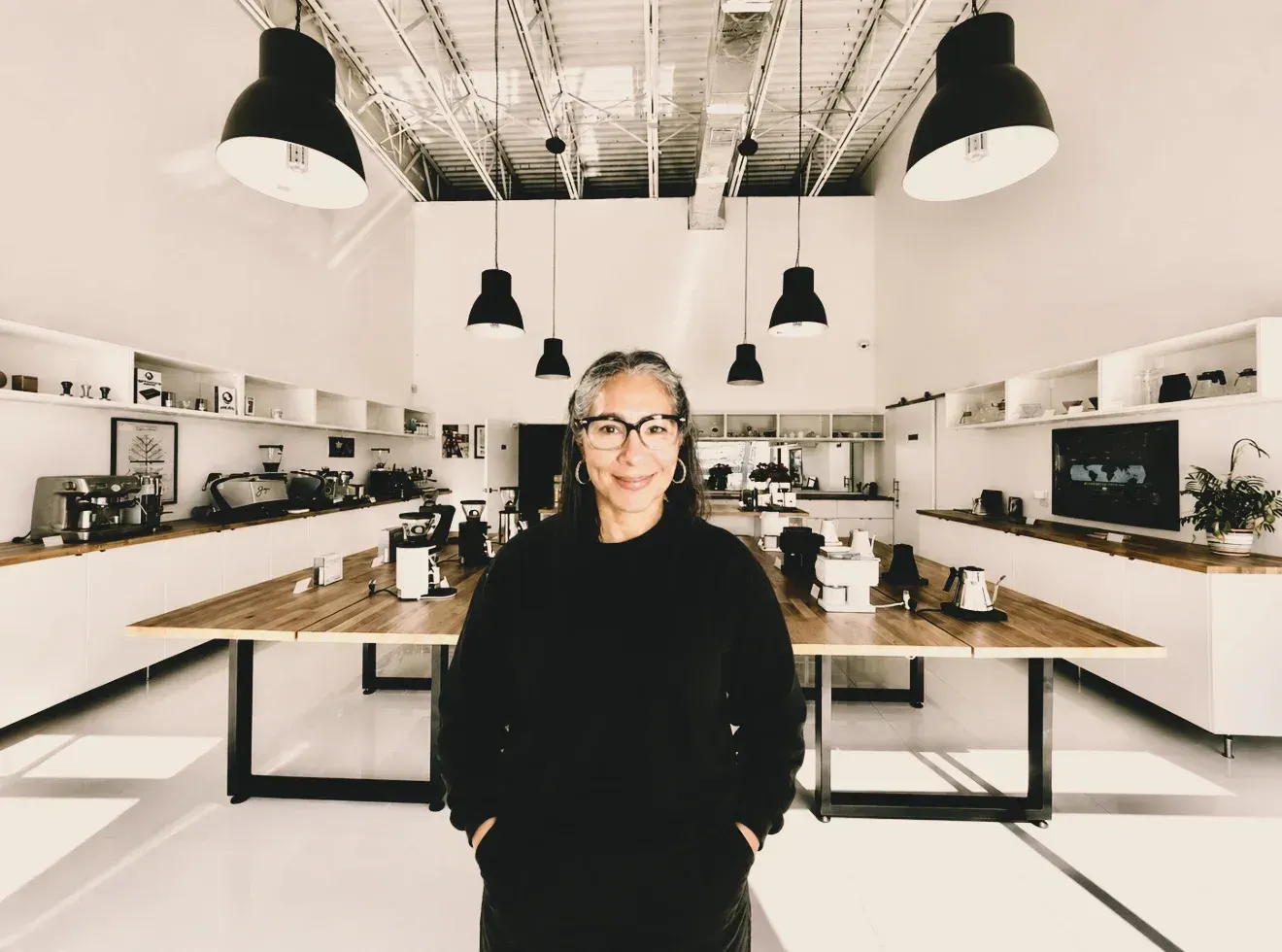
María Esther Thome-López, coffee educator and roaster, Miami, Florida. Four questions — everything the industry rarely stops to hear.

Coffee people.
The Better Coffee Standard defines it precisely: everyone whose life and work are bound to coffee, at every stage of the coffee circle — including those working under coercion, economic dependency, or without pay. Their families. Those who keep them standing.
Read more in the free The Better Coffee Standard.
The industry never stops talking about coffee. It rarely stops to talk about the people behind it. Red Ink Coffee exists, in part, to change that.
Coffee People is a series of portraits. Four questions — their voices.
Who are you and what do you do in coffee?
My name is María Esther Thome-López. I am the co-founder of Coffee Flock®, a coffee roasting company and education center based in Miami, Florida. Before coffee, I practiced law for many years. Coffee was never part of my life plan, but it became the vehicle through which I found a new profession, a global community, and a new way of understanding people. Today, I divide my time between coffee education, sensory evaluation, roasting, writing, and helping others find their place in this industry.
Tell us about a moment in your work with coffee that you're genuinely proud of.
I have been fortunate to experience many memorable moments in coffee. Visiting Ethiopia, the birthplace of coffee, for the first time was certainly one of them. But if I had to choose one moment that stands above the rest, it would be a class I taught in Puerto Rico.
I was teaching a Green Coffee course to a group of more than thirty people representing different sectors of Puerto Rico's coffee industry. What made the experience unique was that many of them had never visited a coffee farm and had never been exposed to green coffee.
For four days, we worked together on a coffee farm, discussing coffee from seed to cup while experiencing firsthand the realities of production. What I remember most is not the curriculum, but the conversations at the end of the course. Many participants became emotional as they reflected on how much their perspective had changed. They began to see coffee not simply as a product, but as the result of people, agriculture, risk, effort, and community.
Watching that transformation happen in real time remains one of the most meaningful experiences of my career. From an emotional perspective, it is one of the pinnacles of my life in coffee.
What's one problem you see in your part of the coffee world — and why does it matter to you personally?
One thing I struggle with in today's coffee industry is the growing distance between coffee itself and the narratives we build around it.
I understand the importance of storytelling. I understand the need for marketing, differentiation, and innovation. Coffee is a competitive industry, and producers, roasters, and businesses need ways to communicate value.
But sometimes I feel we have become so focused on the story that we risk losing sight of the product.
I see it in the increasing complexity of processing terminology, in the constant search for the next innovation, and in the way sustainability claims are sometimes communicated. The more complicated the process name, the more exclusive the coffee appears to become. The more sophisticated the language, the more value we assume it has.
Yet I often find myself asking a simple question: Are we helping people understand coffee better, or are we making coffee harder to understand?
At times, it feels as though we are creating layers of language, marketing, and certification that can overshadow the very thing that brought many of us into coffee in the first place: the sensory experience, the people behind it, and the genuine connections it creates.
What concerns me most is not innovation itself, but the possibility that we begin to confuse novelty with quality, complexity with value, or marketing with impact.
I would like to see an industry that remains curious and innovative while also being more honest, more transparent, and more grounded. An industry that celebrates great coffee without feeling the need to constantly reinvent the narrative around it.
For me, better looks like a coffee industry that spends a little less time chasing the next story and a little more time understanding the one that is already in the cup.
What would you change if you could — and what would better look like for you?
The longer I spend in coffee, the more I realize how complex our industry really is.
Coffee connects producers, exporters, importers, traders, roasters, retailers, educators, governments, NGOs, certification bodies, and consumers across the world. Each part of the supply chain has its own priorities, pressures, and economic realities. Because of that, even when people agree that change is needed, meaningful change can be incredibly difficult to achieve.
If I'm being completely honest, there are moments when I ask myself whether we will ever truly "fix" some of the challenges we talk about so often. We discuss sustainability, equity, climate change, transparency, and producer livelihoods, yet many of these conversations have been happening for decades.
That doesn't mean progress hasn't been made. It has. But sometimes it feels as though the scale and complexity of the system make transformational change difficult to reach.
What matters to me personally is that behind all these discussions are real people.
If there is one thing I would change, it would be our ability to align around long-term solutions instead of short-term interests. I don't believe coffee's future depends on a single company, certification, government, or organization. It depends on whether a very diverse group of stakeholders can work toward a more resilient and sustainable industry together.
I don't know if coffee will ever be "fixed." But I do believe it can be better, and that is reason enough to keep trying.
You are coffee people. Tell us.
Four questions. Any language. Any format.
- Who are you and what do you do in coffee?
- A moment you're genuinely proud of.
- One problem in your part of the coffee world — and why it matters to you.
- What would you change — and what would better look like?
Include a short bio and a photo from your work environment. Send your answers to redinkcoffee@thebettercoffee.org
Support this work
If this text was useful to you, you can support Red Ink Coffee.
Contributions help cover basic infrastructure costs and keep this space independent.
Voluntary. No perks. No obligations.