Coffee People: Fahed Almaghrbi
Fahed Almaghrbi, agricultural engineer and founder of Yemen-at-Coffee, Yemen. Four questions — everything the industry rarely stops to hear.

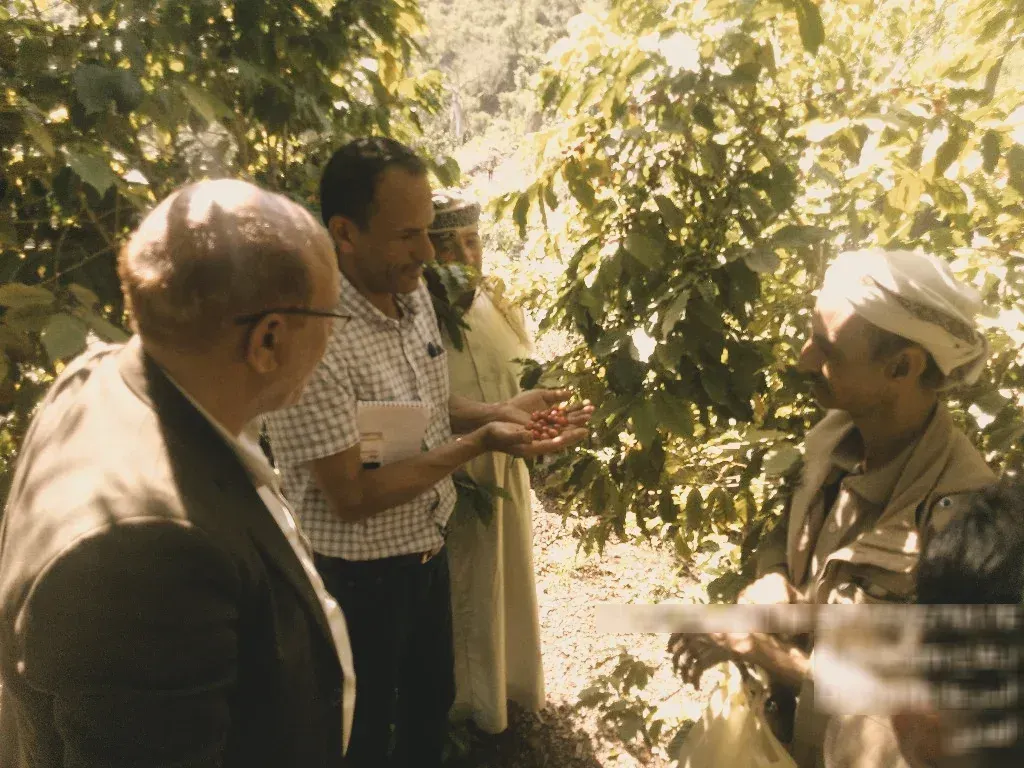
Coffee people.
The Better Coffee Standard defines it precisely: everyone whose life and work are bound to coffee, at every stage of the coffee circle — including those working under coercion, economic dependency, or without pay. Their families. Those who keep them standing.
Read more in the free The Better Coffee Standard.
The industry never stops talking about coffee. It rarely stops to talk about the people behind it. Red Ink Coffee exists, in part, to change that.
Coffee People is a series of portraits. Four questions — their voices.
Who are you and what do you do in coffee?
My name is Fahed Almaghrbi. I am an agricultural engineer working at a coffee research and development center in Yemen, and the founder of Yemen-at-Coffee.
Yemeni coffee is not just an agricultural product. It is one of the most historically significant origins in the global coffee story, known for its genetic diversity and distinctive cup profiles that helped shape the early identity of coffee trade worldwide.
Despite this heritage, the current reality of production and supply chains does not always reflect that historical position. My work focuses on bridging this gap — between scientific agricultural research, field practices, and the economic systems that define how coffee is valued.
Through Yemen-at-Coffee, I try to connect knowledge with production, so that Yemeni coffee is understood not only as a product of tradition, but as a system that can be measured, improved, and trusted economically.
Tell us about a moment in your work with coffee that you're genuinely proud of.
One of the most meaningful moments in my work was seeing Yemeni coffee farmers begin to move from invisibility into recognition within the specialty coffee world.
In many cases, these farmers had been producing exceptional coffee without being part of any structured narrative or market identity. When their work started to be recognized as traceable, meaningful, and connected to origin, it was more than visibility — it was a shift in how value itself is perceived.
It showed me that in coffee, recognition is not symbolic only; it directly affects economic opportunity and long-term inclusion in the value chain.
What's one problem you see in your part of the coffee world — and why does it matter to you personally?
Yemeni coffee has a strong heritage, a unique identity, and exceptional quality. However, several structural issues have created uncertainty among some importers and limited consistent market trust.
The main challenges are: lack of standardized post-harvest processing systems, high variability in farming and processing practices, weak logistics, storage, and supply chain infrastructure, limited traceability and origin transparency, and inconsistent cup quality between different lots and harvests.
It is important to emphasize that these issues do not come from a lack of quality in the coffee itself, but from the absence of stable systems that can reliably express that quality.
As a result, trust becomes fragmented, and economic value does not always reflect the real potential of the product.
What would you change if you could — and what would better look like for you?
What I aim to change through Yemen-at-Coffee is not the identity of Yemeni coffee, but the system that connects that identity to the global market.
The direction we are working toward is: stronger transparency from farm to export, more consistent post-harvest practices to stabilize quality, integration of agricultural research into real production systems, reducing variability between batches through better technical understanding, and linking economic value to measurable and consistent quality outcomes.
For me, "better" means a system where trust is no longer uncertain, but built into the structure itself — where Yemeni coffee is recognized as a reliable origin, and farmers are positioned as active participants in shaping both quality and value.
You are coffee people. Tell us.
Four questions. Any language. Any format.
- Who are you and what do you do in coffee?
- A moment you're genuinely proud of.
- One problem in your part of the coffee world — and why it matters to you.
- What would you change — and what would better look like?
Include a short bio and a photo from your work environment. Send your answers to redinkcoffee@thebettercoffee.org
Support this work
If this text was useful to you, you can support Red Ink Coffee.
Contributions help cover basic infrastructure costs and keep this space independent.
Voluntary. No perks. No obligations.