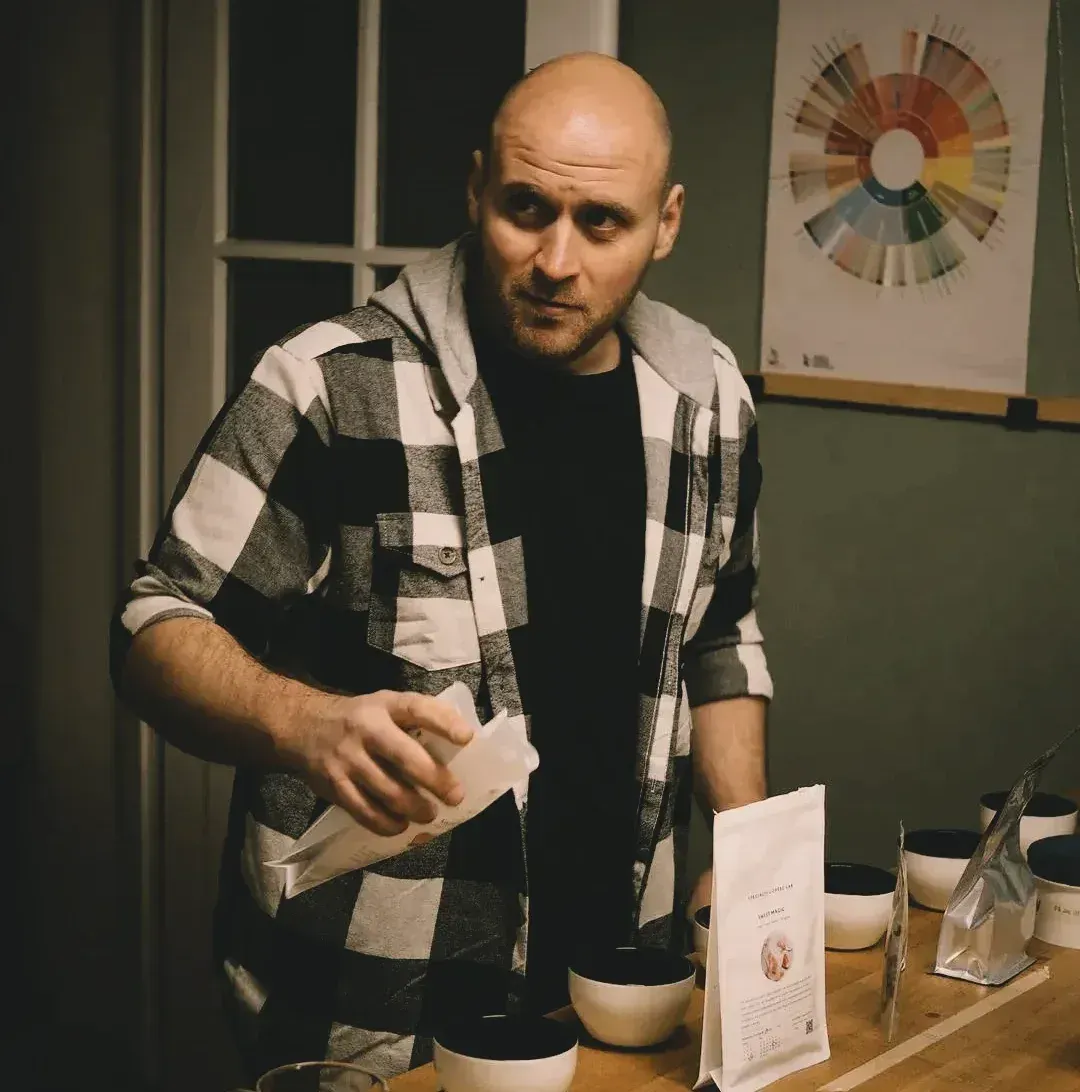
Coffee People: Dénes Rajmond
Dénes Rajmond, coffee roaster, Munich, Germany. Four questions — everything the industry rarely stops to hear.

Coffee people.
The Better Coffee Standard defines it precisely: everyone whose life and work are bound to coffee, at every stage of the coffee circle — including those working under coercion, economic dependency, or without pay. Their families. Those who keep them standing.
Read more in the free The Better Coffee Standard.
The industry never stops talking about coffee. It rarely stops to talk about the people behind it. Red Ink Coffee exists, in part, to change that.
Coffee People is a series of portraits. Four questions — their voices.
Who are you and what do you do in coffee?
My name is Dénes Rajmond. I live in Munich and work as a coffee roaster. I've been working with coffee for over 10 years, and I also participate in coffee competitions from time to time, with varying degrees of success — including two German Cuptasters Championship titles (2020, 2022) and two World Cuptasters Championship finals (2nd place in 2021, 4th in 2022).
As my brand's slogan says, I consider myself a simple coffee lover.
Tell us about a moment in your work with coffee that you're genuinely proud of.
I'm proud of many things, from my achievements in competitions to the popularity of the coffees I roast.
But perhaps I should say that I'm most proud of being a good role model for the new generation of baristas, showing them that hard work and perseverance can take you far.
I'm always ready to support up-and-coming young talents in competitions, as long as I feel they have the right attitude.
What's one problem you see in your part of the coffee world — and why does it matter to you personally?
I'd approach this from two distinct perspectives, since I encounter both in my work.
The first problem—which is often a headache—is a lack of human resources; and even when there are enough people, the complexity of working with coffee is all too often underestimated.
The other issue that affects me as a coffee buyer and roaster is the lack of transparency, even when everything is presented as 100% true and transparent.
When I first got into specialty coffee, it meant something different to me. The origin of the coffee itself—the character of the terroir—played the leading role. These days, we get dozens of coffees that smell and taste 99% identical, regardless of whether they come from Colombia, Costa Rica, Ecuador, or even India.
With a few exceptions, such as Kenya and Ethiopia, the coffee industry is moving too much in one direction.
What would you change if you could — and what would better look like for you?
This is perhaps the hardest question.
I believe that proper education should play a significantly greater role in every area.
From developing the knowledge of coffee growers, through expanding the expertise of coffee roasters, all the way to baristas—improvement is needed across the board.
And there's one thing we mustn't forget. We must also educate the end user—that is, the consumer—and transparently inform them about what actually ends up in their cup.
You are coffee people. Tell us.
Four questions. Any language. Any format.
- Who are you and what do you do in coffee?
- A moment you're genuinely proud of.
- One problem in your part of the coffee world — and why it matters to you.
- What would you change — and what would better look like?
Include a short bio and a photo from your work environment. Send your answers to redinkcoffee@thebettercoffee.org
Support this work
If this text was useful to you, you can support Red Ink Coffee.
Contributions help cover basic infrastructure costs and keep this space independent.
Voluntary. No perks. No obligations.