Coffee People: Tasmin Grant
Tasmin Grant, Managing Editor, Perfect Daily Grind. Four questions — everything the industry rarely stops to hear.

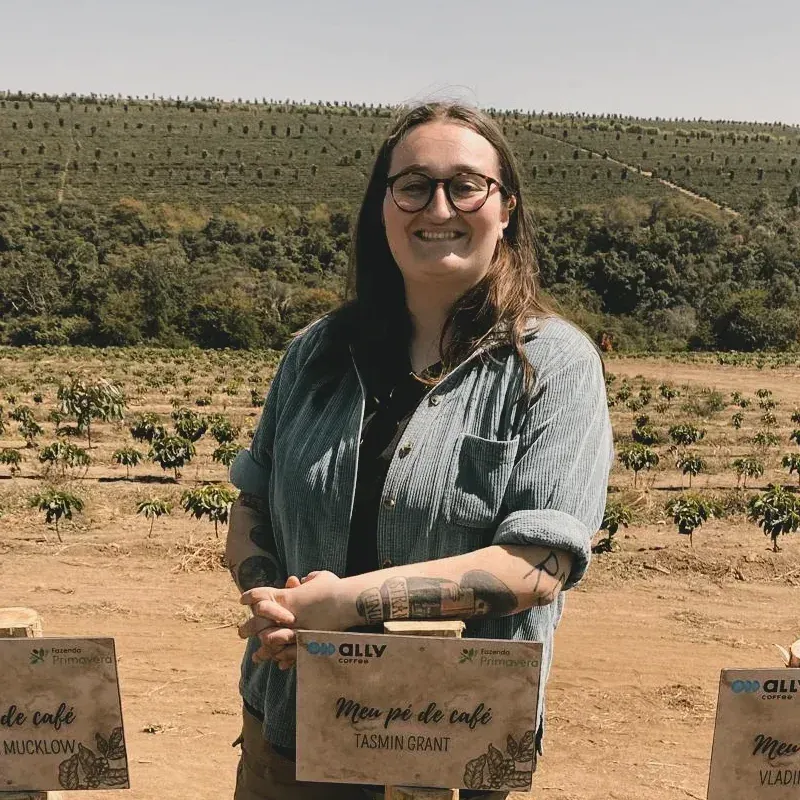
Coffee people.
The Better Coffee Standard defines it precisely: everyone whose life and work are bound to coffee, at every stage of the coffee circle — including those working under coercion, economic dependency, or without pay. Their families. Those who keep them standing.
Read more in the free The Better Coffee Standard.
The industry never stops talking about coffee. It rarely stops to talk about the people behind it. Red Ink Coffee exists, in part, to change that.
Coffee People is a series of portraits. Four questions — their voices.
Who are you and what do you do in coffee?
Hello, I'm Tasmin!
I've worked in coffee for over ten years now. I started out managing a (very) busy chain coffee shop on a university campus in the UK, then moved to Canada, where I worked as a barista in my first specialty coffee shop. A few cafés and countries later, I began freelance writing for Perfect Daily Grind. From there, I worked my way up to managing editor.
A moment in your work with coffee that you're genuinely proud of.
Going to my first big trade show and meeting people I'd only emailed or chatted with on video calls. I bumped into Andrea Allen of Onyx Coffee Lab, and she remembered me from a few brief email exchanges. I was so taken aback. It made me realise that I was leaving a lasting impression on people, even though we'd never met in person. That's something I love about the coffee industry: everyone is happy to chat and share what they know. You can connect with anybody. I've also been lucky enough to visit coffee farms in Brazil twice, and I spoke on a panel during one of those trips. It was great fun! I met wonderful people and made friends for life, and those are memories I'll always cherish.
One problem you see in your part of the coffee world — and why it matters to you personally.
I still feel that specialty coffee can be quite exclusionary. It always will be, to a certain extent. But if you don't have the "right" credentials, ask the "wrong" question, or like the "wrong" things, it's easy to feel intimidated or judged. Co-ferments are a good example, and I'll share an anecdote to explain. I recently went to a new specialty coffee shop with a friend who appreciates good coffee but finds specialty quite pretentious. She usually orders "fun" iced coffees with a bunch of syrups and cold foams, and she feels judged whenever she asks for this in a specialty café. I ordered a strawberry co-ferment as espresso, which she tried and loved. She then started asking questions about what makes co-ferments different from other coffees and where she could buy them. One very fruity espresso became a gateway into specialty coffee. People can be really opinionated about co-ferments, arguing that they're not "pure" or "authentic". I understand this point of view, especially regarding a lack of transparency. But if co-ferments, done well, can make specialty coffee more accessible, then why not embrace them? We can bring more people into the fold.
What would you change if you could — and what would better look like for you?
Oh man, that's a big question. Above all else, we need to find more and better ways to retain value in producing countries, but there are plenty of people much more qualified to speak on this than I am. Buying coffee from roasters at origin is definitely one way to do this, but it's logistically challenging. Right now, I think solidarity across local communities and the entire supply chain is essential. The past few years have been tough for the coffee industry, so banding together is really the only way that we'll come out stronger.
You are coffee people. Tell us.
Four questions. Any language. Any format.
- Who are you and what do you do in coffee?
- A moment you're genuinely proud of.
- One problem in your part of the coffee world — and why it matters to you.
- What would you change — and what would better look like?
Include a short bio and a photo from your work environment. Send your answers to redinkcoffee@thebettercoffee.org
Support this work
If this text was useful to you, you can support Red Ink Coffee.
Contributions help cover basic infrastructure costs and keep this space independent.
Voluntary. No perks. No obligations.