Coffee People: Hossain Dalaoawar
Hossain Dalaoawar, barista and baker from Bangladesh. Four questions — everything the industry rarely stops to hear.

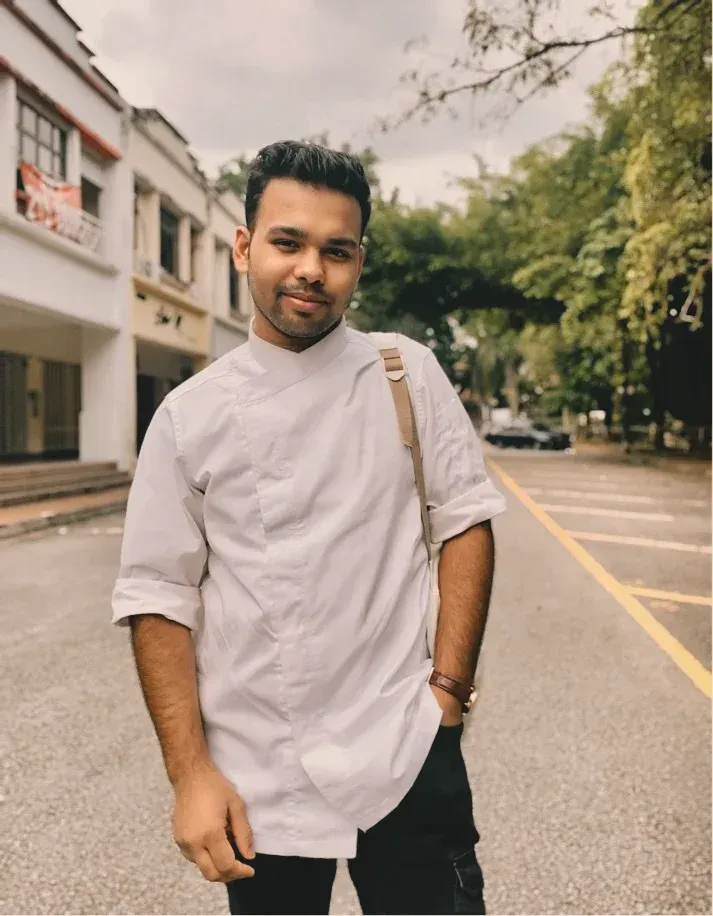
Coffee people.
The Better Coffee Standard defines it precisely: everyone whose life and work are bound to coffee, at every stage of the coffee circle — including those working under coercion, economic dependency, or without pay. Their families. Those who keep them standing.
Read more in the free The Better Coffee Standard.
The industry never stops talking about coffee. It rarely stops to talk about the people behind it. Red Ink Coffee exists, in part, to change that.
Coffee People is a series of portraits. Four questions — their voices.
Who are you and what do you do in coffee?
My name is Hossain Dalaoawar. I'm from Bangladesh, and right now I'm in Malaysia, studying Hotel Management and working as a baker. I've spent around five years in coffee and bakery — pulling espresso, dialing in manual brews, working the bar, looking after people on the other side of the counter.
Coffee, for me, was never just a drink. It's the reason a stranger and I end up talking. Every cup is a small chance to make someone's day a little better — the regular who knows exactly what they want, and the person walking in for the first time, unsure. This work taught me patience, consistency, and respect for the small details most people never notice. That's the part I love: the details nobody sees, but everybody tastes.
A moment in your work with coffee that you're genuinely proud of.
The thing I'm proudest of isn't a competition or a certificate. It's the regulars who walk in and ask for me by name — who want their coffee made by my hands, because they trust the care I put into it. You can't fake that. It's earned one cup at a time, and it means more to me than any single prize.
I'm also proud of how far I've come. I started barely understanding extraction and milk steaming. Now it's second nature, and I've learned to read people as well as I read a shot. Every shift, I got a little better. I'm still getting better.
One problem you see in your part of the coffee world — and why it matters to you personally.
Here's the truth, from where I stand: in this industry, a lot of skilled people are judged by the passport they hold, not the work they do. I know this because I live it. As a migrant worker, my ability isn't the first thing anyone sees — my nationality is. Doors that open easily for others, I have to prove myself twice to even approach.
And it goes deeper than being overlooked. The barrier isn't skill — it's paperwork. A visa. For people like me, that single document decides everything, and the industry knows it. It's why so many of us are pushed to a desperate place: ready to work months for free, to give away our labour, just to earn the sponsorship that might lead to a visa. Think about what that means. Not paid poorly — paid nothing, by choice, because unpaid work is the only door left open. That isn't opportunity. It's how a broken system turns talent into something people feel they have to give away.
What would you change if you could — and what would better look like for you?
I would break the link between where a person is born and what they're allowed to become. Talent exists everywhere — I've seen it in kitchens and behind bars in places the industry never looks. Opportunity doesn't follow it. That gap is the thing I'd close: real pathways for hardworking people to grow through training, mentorship, and honest, paid employment — not empty promises, and not unpaid "trials" traded for the hope of a visa.
Better, to me, looks like a coffee world where people are respected, paid fairly, and trusted to keep learning, wherever they come from. For myself, I hope one day to work in specialty coffee in Europe — and I'll be honest about what that really means: it means a visa. It always comes back to the visa. Not skill, not passion, not five years behind the bar — a stamp in a passport that decides whether any of the rest is even allowed to count. I hope my story tells someone else, somewhere far from the centre of this industry, that dedication still means something — even when the paperwork tries to say it doesn't.
You are coffee people. Tell us.
Four questions. Any language. Any format.
- Who are you and what do you do in coffee?
- A moment you're genuinely proud of.
- One problem in your part of the coffee world — and why it matters to you.
- What would you change — and what would better look like?
Include a short bio and a photo from your work environment. Send your answers to redinkcoffee@thebettercoffee.org
Support this work
If this text was useful to you, you can support Red Ink Coffee.
Contributions help cover basic infrastructure costs and keep this space independent.
Voluntary. No perks. No obligations.